The "Soft" Pencil Whip: Why Internal Store Audit Scores Are Lying to You (And How AI Fixes It)
How OpsAnalitica's AI photo grading restores true operational visibility.
If you pull up the internal audit dashboard for your multi-unit brand right now, what does the average score look like?
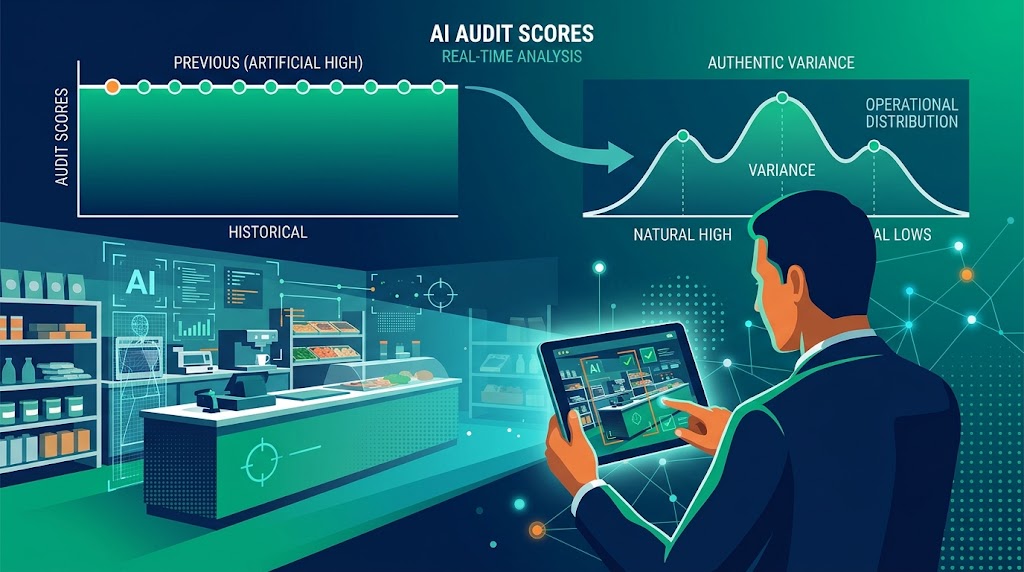
Across the industry, when enterprise operators analyze their monthly internal audit data across hundreds of locations, they routinely see scores consistently in the high nineties with very little variation.
On paper, audit scores in the high nineties look like operational perfection. But every experienced executive knows the ground reality: stores have dirty coolers, line checks get missed, displays are misaligned, and standards slip during peak hours. Operational research and audit benchmarking confirm that accurate inspection programs should yield a wide variation of scores. Seeing consistently high, flatlined audit scores is not a sign of operational excellence—it is a red flag that your audit program is broken.
The problem isn't always "hard" pencil whipping, where someone checks off an entire audit form in 60 seconds from their car.
The far more dangerous culprit is "Soft" Pencil Whipping—a subtle, systemic inflation of audit scores carried out by dedicated Above-Store Leaders (ASLs) and District Managers who are responding to structural organizational incentives.
Here is why your internal leaders soft pencil whip their audits, why executive leadership gets trapped making decisions on bad data, and how AI photo grading restores true operational truth.
The Behavioral Economics of the "Soft" Pencil Whip
Above-Store Leaders (ASLs) do not soften audit scores because they are lazy or incompetent. They do it because enterprise multi-unit operations create powerful behavioral incentives that force ASLs to protect store managers and fudge audit answers.
When an ASL conducts an internal audit, they aren't just filling out a rubric—they are navigating complex organizational relationships and personal incentives:
1. The Desire to Be Liked & Build Buy-In
Auditing is only a small fraction of an ASL's job description. Their highest value comes from coaching, mentoring, and getting Store Managers to execute new initiatives, menu rollouts, or operational changes. ASLs know that failing a Store Manager on an audit damages trust and creates friction. Softening an audit score by giving "do-overs" or ignoring minor infractions keeps working relationships smooth.
We have heard it time after time: one of the biggest complaints that executives have with their ASLs is that they don't have the hard conversations. Yet those hard conversations lead to the right operational changes in the stores—which directly drives higher sales and profits.
2. Protecting Store Manager Bonuses & Retaining Talent
In many organizations, failing an internal audit directly disqualifies a Store Manager from receiving their quarterly bonus. When an ASL knows a manager will lose their financial bonus over a few flagged items, they are strongly incentivized to slide the score up by 2 or 3 points so the manager passes.
3. The Quality of Life Penalty: Covering Shifts
If an audit failure leads to a frustrated Store Manager quitting, who fills the vacuum? In corporate chains, the ASL often has to step in and physically work as the General Manager in that store until a trained replacement is found. Working 70-hour weeks pulling double duty as both GM and District Manager severely impacts the ASL's quality of life. The incentive to avoid "hard" grading is directly tied to job survival.
4. Franchise Sales & Corporate Initiatives
In franchise organizations, ASLs double as corporate relationship managers. They need franchisees to invest capital in brand remodels, new POS rollouts, and unit expansion. An ASL who delivers harsh, punitive audit scores ruins the goodwill required to pitch expensive corporate initiatives.
5. The Fear of Executive Blame
If an ASL reports the honest, unvarnished state of failing stores across their district, upper management rarely praises their honesty. Instead, executive leadership assumes the underperformance is the ASL's fault. To protect their own job security, ASLs naturally keep scores artificially high.
[ ASL Conducts Audit ] ➔ [ Identifies Deficiency ] ➔ [ Faces Relationship/Bonus Risk ] ➔ [ Soft Pencil Whip (Fudges Score) ] ➔ [ Corporate Receives Fake Data ]
How AI Photo Grading Eliminates the ASL Conflict of Interest
The solution is not to punish Above-Store Leaders—it is to remove scoring authority from them entirely.
With OpsAnalitica's OpsPhotoAnalyzer, the ASL still conducts the physical store walk, but the AI grades the evidence.
[ ASL Walks Store ] ➔ [ Captures Required Photo ] ➔ [ OpsPhotoAnalyzer AI Grades Image ] ➔ [ Unbiased Real-Time Score ]
When an ASL takes a photo of a station, the OpsPhotoAnalyzer AI engine evaluates the visual data against corporate criteria, assigning an instant, objective pass or fail[cite: 1, 2].
Because the AI does the grading, the ASL is completely off the hook. They are no longer the "bad cop" failing the Store Manager; the AI handles the unbiased enforcement[cite: 1, 2]. The ASL can step into their true, high-value role: an objective coach who helps the Store Manager fix the issues identified by the AI, sparking the exact hard conversations needed to drive real store performance.
Built-In AI Guardrails & Telemetry
What happens if an ASL tries to help a store manager "stage" an area before taking the photo? OpsAnalitica incorporates advanced telemetry and anti-fraud guardrails to capture true operational behavior:
- Audit Duration Tracking: OpsAnalitica measures the precise time elapsed between the first question answered and the last question submitted.
- Too Short: Indicates traditional pencil whipping (rushing through without conducting the walk).
- Too Long: Indicates the auditor stopped repeatedly to help stage or clean areas before capturing required photos.
- Geofencing & Source Verification: Confirms exact physical GPS location during image capture and tracks data sources (human input, bluetooth temperature probes, or live AI camera capture).
- Photo-of-Photo Detection: Prevents users from scanning photos of past passing inspections on digital screens.
Unlocking Tiered Auditing & ASL Efficiency
Because OpsPhotoAnalyzer makes cheating virtually impossible, enterprise brands can fundamentally restructure how internal audits are deployed:
- Store-Level Self-Auditing: High-performing, trusted locations can take their own audit photos. The AI verifies the photos with 100% objectivity, freeing ASLs to focus on coaching, strategizing, and other high-value activities.
- Tiered ASL Resource Allocation: ASLs can adopt a tiered management strategy—letting top-tier stores self-audit while focusing 80% of their physical field visits on struggling, low-tier stores that need coaching and hands-on intervention.
Key Operational Metrics Impacted
Transforming internal audits with AI scoring delivers accurate operational visibility while freeing field leadership to coach. Also, this allows you to have ASLs working with more stores or reduces your need to hire new ASLs for a while as your brand expands:
Key Operational Metrics Impacted
- Audit Score Variance & Accuracy: Restores authentic data variance curves, replacing fake high-ninety averages with true operational distribution data.
- Audit Defect & Pencil-Whipping Rate: Reduces soft pencil whipping and score tampering to near zero via mandatory AI visual grading.
- ASL Coverage Capacity & Coaching Hours: Increases ASL store capacity—allowing current ASLs to manage more units and delaying new ASL hiring needs—while reallocating time to high-value field coaching.
Restoring Truth to Operational Data
Executive leadership cannot run a multi-unit business on fake audit averages in the high nineties. When internal audit data is softened by structural incentives, executive decisions regarding capital allocation, training programs, and operational fixes are doomed to fail.
By combining human walkthroughs with OpsAnalitica AI photo grading, enterprise brands eliminate the soft pencil whip, remove the conflict of interest from field leaders, and gain the accurate visual truth required to drive true operational excellence.
We know you're likely wrestling with a paper process right now, perhaps even contemplating hiring someone to fix it. Instead, click the chatbot at the bottom of this page and ask us about that exact process. There's no commitment, no cost, just a straightforward conversation. We'll help you dissect your current workflow and explore how OpsAnalitica could potentially make it smoother, more efficient, and more effective—all without adding another salary line item. If we're not the right fit, that's perfectly fine. You'll have invested a few minutes learning, and we frequently suggest alternative solutions when we're not the best option. But what if we are the perfect fit? Imagine freeing up valuable resources and gaining unprecedented control over your operations.
Ready to Improve Your Operations?
Get our FREE checklists to streamline processes, boost efficiency, and save time.