Why AI Photo Analysis Just Made the $300 Third-Party Audit Obsolete
AI-scored internal inspections using OpsAnalitica's OpsPhotoAnalyzer

For decades, enterprise multi-unit restaurant, retail, and hospitality brands followed an unwritten rule of operations: if you want an unbiased audit of your stores, you have to pay a third-party firm to do it.
It was never a perfect model. Paying $150 to $300 per visit meant corporate could only afford to audit each store once per quarter. For a 100-unit chain, that is $60,000 to $120,000+ per year to have an external inspector on-site for roughly 4 to 8 hours out of 8,760 annual operating hours—representing less than 0.1% of operating time generating 100% of your compliance record.
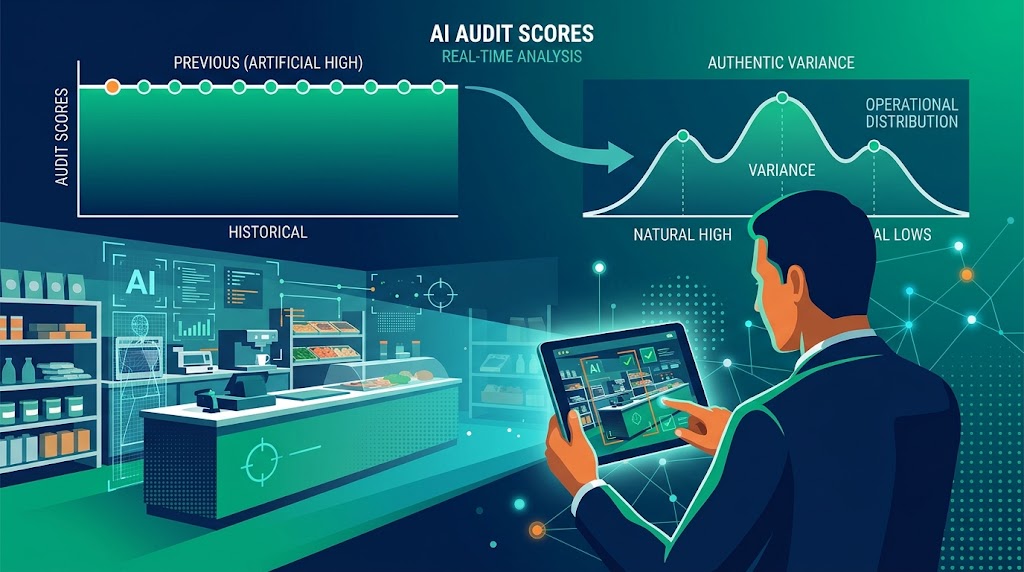
Worse, academic research proves human inspectors suffer from order bias, schedule fatigue, and historical preconceptions, while store teams master the art of staging 20-minute compliance theater the second an auditor walks through the door.
Despite these flaws, executive leadership tolerated the expense because traditional internal self-auditing was fundamentally broken by score inflation and pencil whipping. Third-party auditing was simply the best option available.
Artificial Intelligence has flipped that model on its head.
With the arrival of real-time AI visual evaluation, you no longer need to outsource your brand standards verification to an expensive vendor. You can now run a higher-frequency, fully objective internal audit program powered by AI—achieving far greater accuracy at a fraction of the cost.
The False Dilemma: Why You Paid for Third-Party Inspections
To understand why AI changes everything, we must look at why brands adopted third-party inspectors in the first place.
Historically, corporate executives faced a strict trade-off:
- Pay External Vendors: Spend millions across enterprise footprints for third-party inspectors who provided an independent, unbiased score.
- Trust Internal Teams: Allow Store Managers or District Managers to grade themselves, resulting in inflated 99% pass rates that hid operational failure until customer reviews or health departments stepped in.
Third-party audits were not selected because they were remarkably effective; they were selected because they were the only tool capable of providing third-party objectivity.
The Inherent Failure Modes of Vendor Inspections
Peer-reviewed operational research shows that paying $300 per visit never actually guaranteed objective accuracy:
- Inspector Bias & Fatigue: Studies prove inspectors cite fewer violations when fatigue sets in late in the workday or when detailed reporting threatens to prolong their shift. An inspection conducted at 4:45 PM is judged by a measurably different standard than one conducted at 9:00 AM.
- Prior-Store Order Effects: Research reveals inspectors cite more violations after inspecting stores with poor compliance records, applying harsher standards to the next location on their schedule regardless of its actual condition.
- The Staged Performance: Announced or unannounced, an experienced store manager can stage a facility in minutes. Third-party audits measure how well your team can put on a performance while a visitor is standing in the lobby, not how your store runs when leadership leaves.
The New Reality: Internal Audits Powered by AI Photo Analysis
OpsAnalitica replaces the third-party inspector with a hybrid model: Internal Human Execution + AI Algorithmic Scoring.
Instead of paying an outside vendor to walk your store, an internal leader (Store Manager, District Manager, or internal auditor) performs the physical walkthrough. However, they do not score the audit.
[ Internal Leader Walks Store ] ➔ [ Captures Required High-Res Photos ] ➔ [ OpsPhotoAnalyzer AI Scores Image ] ➔ [ Pass / Immediate Action ]
As the team member walks the floor, OpsPhotoAnalyzer requires them to capture high-resolution photos of specific audit stations—from prep lines and walk-in coolers to customer seating and dumpsters. The OpsAnalitica AI engine instantly evaluates the photograph against corporate standards, applying a pass/fail determination and generating detailed written evidence in real-time[cite: 1, 2].
Why AI Scoring Is Superior to Third-Party Vendors
- Zero Cognitive Bias: The AI algorithm evaluates every single photo against identical criteria. It never experiences 4:45 PM workday fatigue, never remembers past store performance, and never alters scoring based on prior visits.
- Pencil-Whip Proof: An internal employee cannot negotiate with or manipulate an AI visual model. If line items do not meet brand standards, the AI flags them instantly[cite: 1, 2].
- Fraction of the Cost: Because you are utilizing existing internal store footprint leaders to capture photo evidence, the cost per audit drops dramatically. Brands eliminate external vendor markups, travel fees, and re-audit penalties.
Key Operational Metrics Impacted
Replacing third-party inspection vendors with an AI-driven internal audit model fundamentally alters your operating economics:
Key Operational Metrics Impacted
- Annual Inspection Budget Spend: Cuts total audit program spend by 60%–80% by eliminating external third-party vendor fees, travel overhead, and re-audit surcharges.
- Audit Touchpoint Frequency: Increases brand verification touchpoints from 4 times per year to monthly or weekly without increasing vendor spend.
- Corrective Action Resolution Time: Reduces audit failure resolution lag from 3+ days (vendor report delivery) to real-time, on-site remediation.
Financial Breakdown: Third-Party Vendor vs. OpsAnalitica AI Internal Model

The Decision for Executive Leadership
Third-party audits served a purpose when paper checklists and subjective human reviews were the only options available. But continuing to spend tens or hundreds of thousands of dollars annually on infrequent, bias-prone vendor visits is no longer financially or operationally defensible.
By placing visual collection in the hands of internal store leaders and transferring all scoring authority to an objective AI engine, OpsAnalitica gives enterprise operators what third-party vendors always promised but could never deliver: unbiased, continuous, high-density operational accuracy at a fraction of the cost.
We know you're likely wrestling with a paper process right now, perhaps even contemplating hiring someone to fix it. Instead, click the chatbot at the bottom of this page and ask us about that exact process. There's no commitment, no cost, just a straightforward conversation. We'll help you dissect your current workflow and explore how OpsAnalitica could potentially make it smoother, more efficient, and more effective—all without adding another salary line item. If we're not the right fit, that's perfectly fine. You'll have invested a few minutes learning, and we frequently suggest alternative solutions when we're not the best option. But what if we are the perfect fit? Imagine freeing up valuable resources and gaining unprecedented control over your operations.
Ready to Improve Your Operations?
Get our FREE checklists to streamline processes, boost efficiency, and save time.