Aug 6, 2026
How OpsPhotoAnalyzer Turns Unstructured Visual Data Into Structured Operational Insights
-
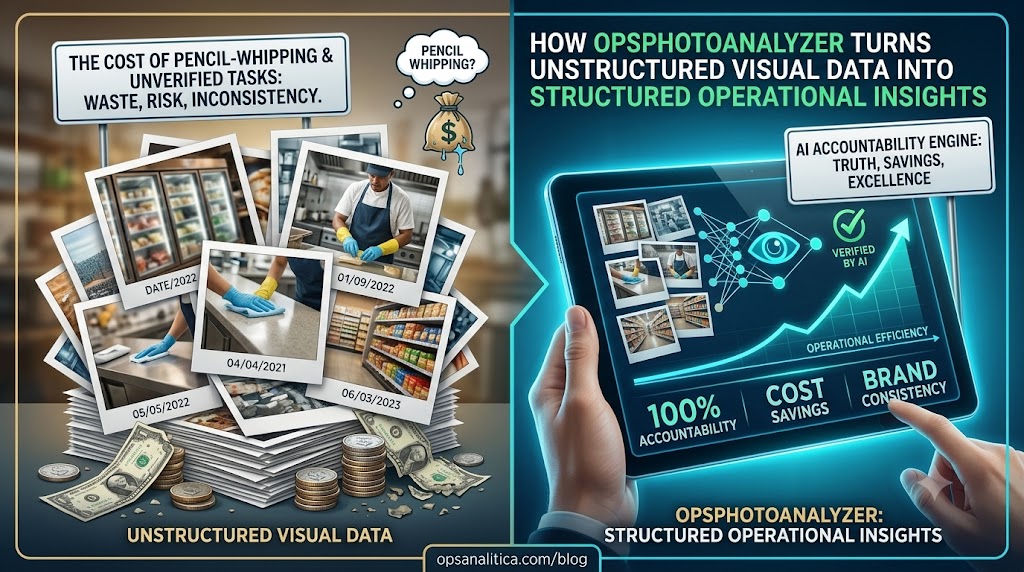
Every day, multi-location businesses generate thousands of photos: a closed cooler door, a stocked display, a completed safety check, a finished prep station. Individually, each photo is just a picture. At scale, that pile of images is one of the richest sources of operational truth a business has, and also one of the most wasted.
OpsAnalitica is an Ops Execution Platform built to close the gap between assigning operational tasks and proving they were carried out correctly, giving multi-location businesses the visibility and data they need to run consistent, accountable operations across every site.
Most businesses collect these photos and then let them sit. A manager might spot-check a handful. The rest go unreviewed, which means the operational truth they contain never becomes a decision leadership can act on. OpsPhotoAnalyzer, part of the OpsAnalitica Platform, exists to close that gap, turning an unmanageable flood of images into structured, searchable, decision-ready data.
Key Takeaways
- Photos collected during daily operations are unstructured data. Without analysis, they cannot be searched, scored, or trended.
- Manual photo review does not scale. As locations grow, review backlogs and inconsistent standards grow with them.
- OpsPhotoAnalyzer applies AI to every submitted photo, converting visual evidence into structured, comparable operational data.
- Structured visual data supports the same scoring, tagging, and reporting functions that drive real operational excellence across a business.
Why Photos Alone Are Not Data
A photo, on its own, tells a manager one thing: what a single location looked like at a single moment. It does not tell them how that location compares to the one across town, whether a pattern is emerging across a region, or whether a task was actually done to standard rather than just documented.
That is the core problem with unstructured visual data. It is evidence, but it is not information. Turning a photo into information requires someone, or something, to look at it, interpret it against a standard, and record the result in a form that can be counted, compared, and reported on. Do that by hand across dozens or hundreds of locations, and the review process becomes the bottleneck.
Academic research backs up what most operators already suspect from experience. A recent peer-reviewed study on automated compliance monitoring found that traditional manual audits are labor intensive, error prone, and costly, which is exactly why interest in automated, computer vision based verification has grown across industries that depend on consistent, on-site execution. Separate industry research has found that a majority of retailers now name real-time operational visibility and loss prevention among their top technology investment priorities, reflecting how central photo and video based verification has become to modern operations.
What "Structured" Actually Means
Turning a photo into structured data means extracting specific, comparable information from it. Instead of a folder of images, a structured system produces:

That transformation, from raw image to standardized record, is what makes the data usable. A single photo cannot be trended. A thousand scored, tagged, and timestamped photos can.
How OpsPhotoAnalyzer Handles the Heavy Lifting
This is where OpsAnalitica's AI-powered photo verification tool comes in. Instead of asking a manager to manually review every photo submitted across every location, OpsPhotoAnalyzer scans each image in real time, checking it against defined brand, safety, or compliance standards and flagging anything that falls short.
That process feeds directly into OpsAnalitica's Business Logic Engine, which builds dynamic, intelligent task flows that adapt based on real-time inputs and guide teams through intelligent troubleshooting logic when a photo indicates something is off. Rather than a static checklist, the workflow itself responds to what the AI actually sees. Combined with advanced scoring, tagging, data collection, and reporting, every photo becomes part of a structured, auditable record instead of a file sitting untouched in a folder.
The result is accountability that does not depend on a manager finding time to scroll through images. Every entry is tied to the person, location, and moment it was captured, which drives accountability across the organization instead of relying on trust alone.

From Visual Noise to Operational Excellence
Operational excellence depends on knowing, with evidence, that standards are being met consistently across every location, not just the ones a regional manager happened to visit this month. Structured visual data is what makes that possible at scale. It lets leadership see patterns instead of anecdotes: which locations consistently pass photo verification, which ones need coaching, and which standards are hardest to maintain across the network.
This matters well beyond compliance and brand standards. Businesses managing operations across multiple restaurant locations rely on this kind of consistent, structured verification to keep food safety and service standards uniform from site to site. And because verified data is more reliable than self-reported data, it also feeds more accurately into processes tied to revenue and billing calculations, where a single unverified or misread input can compound into a larger financial error.
Get Started With a Free Photo Verification Checklist
Use our Photo Verification Checklist for free forever now. It is not just a downloadable PDF like a paper checklist. It is the free version of our app, giving you the same structured, AI-supported photo verification that OpsPhotoAnalyzer runs on, at no cost.
The Bottom Line
Multi-location businesses are not short on visual data. They are short on a way to turn that data into something usable. Every unreviewed photo is a missed opportunity to catch a problem, confirm a standard, or spot a pattern before it becomes a bigger issue. OpsPhotoAnalyzer exists to make sure that data does not go to waste, converting the everyday flood of operational photos into the structured insight leadership actually needs to run a consistent, accountable, high-performing business.
Ready to Improve Your Operations?
Get our FREE checklists to streamline processes, boost efficiency, and save time.