Aug 6, 2026
5 Ways OpsPhotoAnalyzer Reduces the Cost of Operational Non-Compliance
-
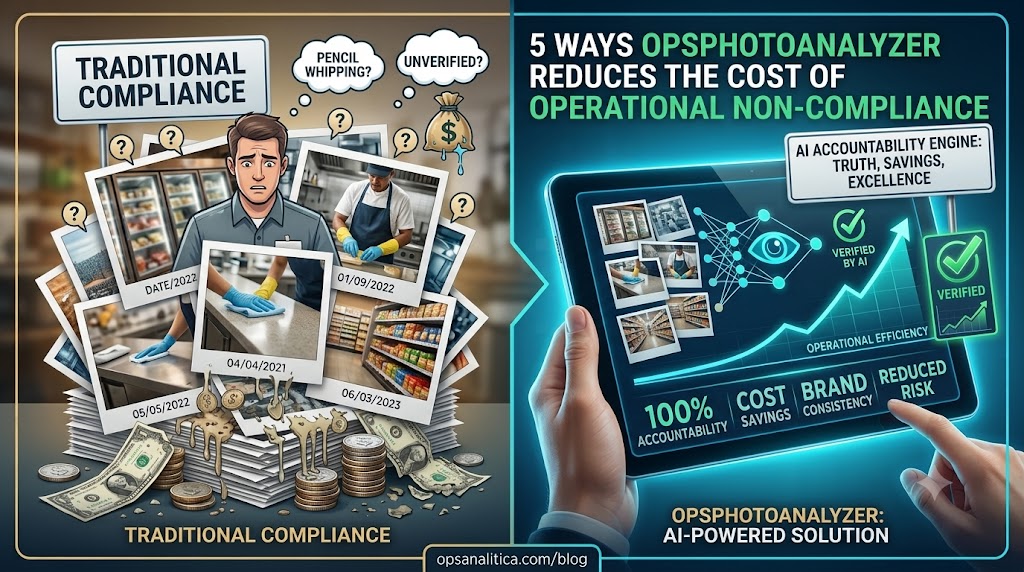
5 Ways OpsPhotoAnalyzer Reduces the Cost of Operational Non-Compliance
Operational non-compliance rarely announces itself. A skipped safety check, a missed display standard, an unrecorded temperature log: none of these show up on a profit and loss statement the day they happen. They show up weeks or months later, as a failed inspection, a shrinkage report, or a customer complaint that traces back to a standard nobody actually verified.
OpsAnalitica is an Ops Execution Platform built to help multi-location businesses close the gap between assigning operational standards and proving they were actually met, giving leadership the visibility and structured data needed to run consistent, accountable operations across every site.
That gap between "assigned" and "verified" is exactly where the cost of non-compliance builds up. Below are five specific ways OpsAnalitica's OpsPhotoAnalyzer helps close it.
Key Takeaways
- Non-compliance is expensive mainly because of what happens after it is discovered, not the initial violation itself.
- Manual photo review does not scale, which means most operational photos are collected but never actually checked.
- OpsPhotoAnalyzer reviews every submitted photo in real time, catching issues before they compound into bigger problems.
- Structured, timestamped visual records reduce the time and cost of proving compliance during audits and investigations.
Why Non-Compliance Costs More Than People Expect
Before getting into the specific ways OpsPhotoAnalyzer helps, it is worth being clear about where the real cost of non-compliance comes from. It is rarely the fine itself. Research from the Ponemon Institute has repeatedly found that the total cost of non-compliance runs well over twice the cost of maintaining proper compliance in the first place, and follow-up analysis of that research points to business disruption, not fines, as the largest driver of that cost once a gap is discovered.
At the store or site level, the picture is similar. One retail sector benchmarking study found that ineffective in-store execution can quietly shrink annual sales revenue by as much as 2% to 5%, a meaningful figure for any multi-location business. In both cases, the damage is not the moment of non-compliance. It is everything that happens because nobody caught it in time.
1. It Catches Problems Before They Compound
Most operational photos are collected and never actually reviewed. A manager checks a handful, and the rest sit in a folder. OpsPhotoAnalyzer changes that by scanning every submitted photo in real time against defined brand, safety, or compliance standards, flagging anything that falls short as soon as it is submitted rather than weeks later during a spot check.
That speed matters because non-compliance compounds. A missed cooler check today can become a failed health inspection next month. Catching the issue on day one, while it is still a small correction, is far cheaper than dealing with it after it has had time to grow.
2. It Replaces Manual Audits With Consistent Automated Review
Manual photo review does not scale. As a business grows from a handful of locations to dozens or hundreds, the review backlog grows right along with it, and standards start slipping in exactly the locations nobody has time to check closely.
A peer-reviewed study on automated visual compliance monitoring found that traditional manual audits are labor intensive, error prone, and costly, which is a major reason interest in automated, computer vision based verification has grown across industries that depend on consistent, on-site execution. OpsPhotoAnalyzer applies that same principle: every photo gets the same consistent review, whether it comes from the flagship location or the newest franchise, without needing a manager to manually work through the backlog.

3. It Builds a Defensible Record for Every Location
When a compliance question comes up, whether from a regulator, an insurer, or a corporate audit team, the businesses that come out ahead are the ones that can produce a record, not just an assurance that a task was done. OpsPhotoAnalyzer ties every reviewed photo to the person, location, and timestamp it was submitted, feeding into the OpsAnalitica Business Logic Engine's advanced scoring, tagging, data collection, and reporting.
That structured record is what drives accountability across an organization. Instead of a manager saying a check was done, there is a timestamped photo and a compliance score to back it up. Industry research on automated visual monitoring has found that this kind of automated tagging and record keeping can meaningfully cut the time it takes to investigate an incident, since the relevant evidence surfaces immediately instead of requiring hours of manual review after the fact.
4. It Standardizes Execution Across Every Location
A single non-compliant location is a local problem. The same gap repeated across dozens of sites is a systemic one, and it is usually invisible from headquarters until a regional pattern finally shows up in the numbers. OpsPhotoAnalyzer gives leadership a consistent, apples-to-apples view of how every location is actually performing against the same standard, not just how each site's manager describes their own performance.
That visibility matters most for businesses managing operations across multiple restaurant locations, where food safety, prep standards, and brand consistency all need to hold steady from site to site. Catching a drifting standard at one location before it becomes the norm across a whole region is a large part of what keeps the cost of non-compliance contained.
5. It Protects Revenue-Critical Data From Silent Errors
Non-compliance is not only a safety or brand issue. Verified, structured visual data also supports the accuracy of processes tied to revenue and billing calculations, where an unverified or misread input can quietly compound into a larger financial error. When the underlying photo evidence has already been reviewed and scored, the data feeding those calculations is far more reliable than a self-reported checklist ever could be.
What This Adds Up To
None of these five points is about adding more oversight for its own sake. They are about closing the specific gap where the real cost of non-compliance builds up: the space between a task being assigned and someone actually confirming it was done. OpsPhotoAnalyzer, part of the OpsAnalitica Platform, closes that gap by turning every submitted photo into a reviewed, structured, and accountable piece of operational data through the platform's Business Logic Engine and advanced reporting capabilities, supporting the kind of Ops Excellence that keeps compliance costs from quietly compounding across a growing organization.
Get Started With a Free Compliance Checklist
Use our Compliance Checklist for free forever now. It is not just a downloadable PDF like a paper checklist. It is the free version of our app, giving you the same structured, AI-supported verification that OpsPhotoAnalyzer runs on, at no cost.
The Bottom Line
The cost of operational non-compliance is rarely the violation itself. It is the disruption, the lost revenue, and the reputational damage that follow once a gap has had time to grow unnoticed. OpsPhotoAnalyzer exists to shrink that window, catching issues early, building a defensible record, and giving multi-location businesses the structured visibility they need to keep small problems from becoming expensive ones.
Ready to Improve Your Operations?
Get our FREE checklists to streamline processes, boost efficiency, and save time.