Aug 25, 2026
5 Reasons You Must Treat AI as an Investment (Not Just Another Flat-Rate Service)
Evaluate AI spend as an investment to maximize operational ROI across stores.
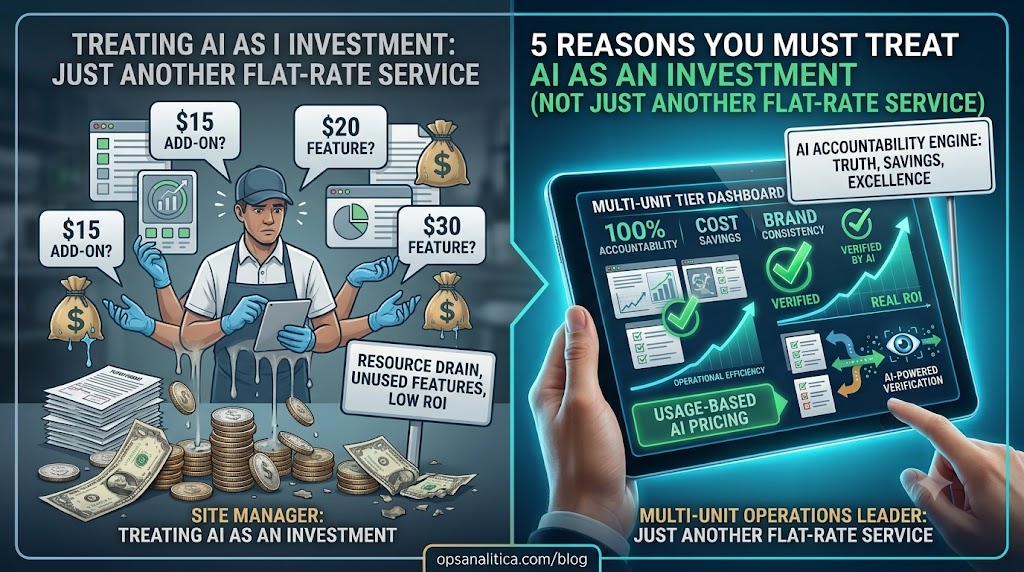
Every modern software platform you touch today is asking you to upgrade to take advantage of its advanced AI features. A $15 charge here, a $20 add-on there—before you know it, your store’s IT spend has doubled or tripled.
Would you buy stock in a company that makes wagon wheels just because it's available? Of course not. So why pay for AI features just because a software vendor popped a bright new button into your dashboard?
From today for the rest of your life, you will be spending money on AI. But because this spend is inevitable, you must treat every dollar of it as an investment, not a casual, flat-rate overhead fee. AI is a revolutionary force multiplier, but only if it delivers a measurable ROI in productivity, efficiency, and time savings. If it doesn't return value, it is a waste of money.
Here are the 5 reasons—and rules—you need to evaluate AI features and plans across your stores to safeguard your bottom line:
1. You Need Proof of Real ROI, Not Shiny Object Syndrome
Never take a software vendor’s word for it—or your team’s initial excitement—when introducing new AI capabilities. Always demand a comprehensive free trial of the AI package and put it through rigorous real-world testing across both corporate offices and field operations. Let your team run wild with the tools for a full month, but hold them accountable with a mandatory survey at the end of the trial period.
Don't settle for vague feedback like "it was cool" or "it felt faster." Ask point-blank: Did this tool actually save you time? Did it make you measurably more productive? If they say yes, demand at least three concrete examples of specific workflows where it eliminated friction or saved labor hours. Sometimes, employees behave like kids who want a shiny new toy simply because they are bored with their current software. To keep everyone grounded, frame the trial strictly around ROI. You might even inform them that funding this AI tool requires taking budget directly from another department—a strategy that forces your team to evaluate if the productivity boost genuinely justifies the expense.
2. Flat-Rate Plans Hide Serious Risks, Throttling, and Surprise Costs
Flat-rate pricing sounds simple and safe on paper, but it often masks operational hazards that can derail your daily business. Before signing up, you must dig into the granular details of the provider’s pricing architecture. Can you selectively grant access to specific high-value users, or are you forced into an all-or-nothing model where you pay for licenses your store-level staff will never open?
Even worse, you need to understand what happens when your usage skyrockets during peak seasons or large operational pushes. If usage spikes under a flat-rate tier, will the provider throttle your processing speeds? Is there a risk that a mission-critical business feature will abruptly stop running because your organization exceeded an invisible monthly quota? If overage charges kick in, are those rates standard, or will you face penalizingly high rates that blow up your IT budget? Uncovering these hidden operational limits upfront prevents disastrous surprises on your monthly invoice.
3. Usage-Based Pricing Keeps Your Spend Aligned with Actual Value
While a credit or usage-based token model might feel intimidating or unpredictable at first glance, it is overwhelmingly superior for managing operational software spend. Flat-rate subscriptions trick operators into paying fixed monthly fees for high-end features that sit idle most of the month. You end up subsidizing the vendor's platform overhead rather than paying for direct utility.
With a pay-as-you-go credit or token framework, you only pay for the exact compute power your team consumes. If a feature sits unused during a slow week, your cost drops to zero. If a high-impact workflow processes thousands of transactions, you pay precisely for the value delivered. This pricing alignment forces your vendor to continuously deliver features that your team actually wants to use, ensuring your software spend scales strictly alongside true operational engagement.
4. You Must Track Usage Down to the Individual User to Eliminate Waste
Adopting AI across a multi-unit organization without user-level tracking is like handing out company credit cards without asking for itemized receipts. To protect your bottom line, insist on software platforms that offer granular reporting capabilities, allowing management to track token and credit consumption right down to the specific user.
Without this visibility, a small subset of employees will inevitably waste expensive AI credits on trivial, low-value tasks that burn through your budget without driving business outcomes. Granular tracking lets leadership pinpoint top performers who leverage AI for maximum efficiency, while simultaneously identifying and retraining users who misuse or waste enterprise credits. Accountability at the user level guarantees that every token spent translates directly into operational output.
5. AI Is Evolving Too Fast to Pay for Subpar Features Today
Because software platforms are pouring endless capital and research into artificial intelligence, the feature landscape is evolving at a breakneck pace. You should focus exclusively on deploying AI capabilities that deliver an immediate, undeniable return on investment today—and ruthlessly skip the rest.
If you evaluate a software provider’s AI features and find them underwhelming, clunky, or overpriced, do not compromise. Walk away and wait six months. The speed of innovation in this sector guarantees that if a feature isn't ready or cost-effective right now, a vastly superior, more economical version will be available in the near future. Holding out for proven, high-ROI tools prevents you from locking your organization into outdated, low-value subscriptions.
Key Operational Metrics Impacted
Adopting an AI-driven approach to multi-unit operations delivers measurable impact across key executive metrics:
- Audit Accuracy Rate: Elevates audit data verification to 100% by replacing subjective human checklists with automated AI photo validation.
- Field Team Inspection Hours Saved: Cuts field travel overhead and eliminates manual inspection hours for District Managers.
- Audit Defect Reduction Rate: Drives immediate real-time behavior change at the store level with zero human follow-up required.
Rethinking the Organizational Setup: The Real AI Dividend
As your AI spend increases and you gain real productivity, you must look at your current organizational setup and ask: What can we cut or change based on the efficiency we've gained?
If you spend a lot of money on AI and your organization looks exactly the same in five years as it did last year, you are doing it wrong. AI is a revolutionary technology that transforms business operations. To maximize your ROI, ask yourself: Now that we have AI, do we need to do this like we always have, or is there a better way?
Take store audits and inspections as an example. Historically in multi-unit businesses, operators send Field Business Consultants (FBCs) or District Managers (DMs) to perform store audits. This requires team members to travel, spending hours walking stores to verify compliance manually.
Today, AI can analyze store inspection photos for roughly a nickel a photo to determine if they pass or fail.
Think about what that actually means for your operational model. Instead of burning thousands of dollars in travel expenses and field labor hours, you can field a brand standards audit or compliance inspection directly to the store-level team. Store employees take the photos, the AI evaluates them instantly, and you get the exact same objective audit results you would have received from sending a human inspector—all for roughly five cents an image.
By offloading the visual verification to AI, you can finally trust and verify the data coming directly from your locations without having to send a babysitter. This frees up your field operations team from acting as expensive checklist checkers, keeping them focused exclusively on coaching managers, supporting franchisees, and generating real, high-value growth for your stores.
Do you still need to send people to stores to conduct those same manual inspections? And if AI handles the heavy lifting of compliance verification, do you really need as large of a field team as you have today?
These are the exact strategic questions you must ask as you deploy AI into your operations.
At OpsAnalitica, we built an autonomous accountability engine that changes this paradigm completely.
The Power of OpsAnalitica: Autonomous Accountability
OpsAnalitica goes far beyond simple paper-replacement or basic digitization tools. It serves as your enterprise's central nervous system by pairing our Business Logic Engine with our proprietary OpsPhotoAnalyzer.
How It Works:
Store Manager Takes Photo ➔ OpsPhotoAnalyzer Checks Criteria ➔ Instant Pass/Fail & Detailed Explanation
- Real-Time Behavior Change: Photos provide the ultimate accountability. The OpsPhotoAnalyzer sends images to AI in real time based on your business criteria. The AI returns an instant "Pass" or "Fail" with a detailed explanation. If it fails, the store manager is forced to fix the issue and retake the photo immediately—driving behavior change with zero human follow-up.
- Unmatched Platform Logic: Paired with our Business Logic Engine, OpsAnalitica handles complex calculations, custom KPIs, and AI-friendly data tagging.
- Maximum Efficiency for Floor & Leadership: Dynamic checklists, audits, and intentional randomization keep store-level forms short, fast, and relevant. Leadership shifts from reading massive report stacks to "Managing by Exception," granting instant access to actionable data.
- Turnkey Implementation: We deliver the platform fully configured to your exact operational specs—eliminating setup headaches and delivering immediate compliance cost savings.
We know you're likely wrestling with a paper process right now, perhaps even contemplating hiring someone to fix it. Instead, click the chatbot at the bottom of this page and ask us about that exact process. There's no commitment, no cost, just a straightforward conversation. We'll help you dissect your current workflow and explore how OpsAnalitica could potentially make it smoother, more efficient, and more effective—all without adding another salary line item. If we're not the right fit, that's perfectly fine. You'll have invested a few minutes learning, and we frequently suggest alternative solutions when we're not the best option. But what if we are the perfect fit? Imagine freeing up valuable resources and gaining unprecedented control over your operations.
Ready to Improve Your Operations?
Get our FREE checklists to streamline processes, boost efficiency, and save time.